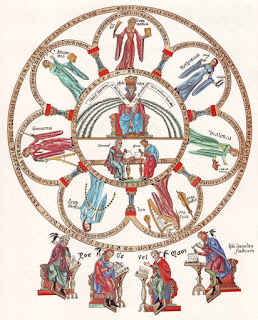
Last spring, I went to the Great Homeschool Convention in Fort Worth, TX with a big question. For a couple of years, I had been studying the liberal arts on my own. I'd read pretty widely and thought I understood the first three arts, the trivium. As I began to try to understand the quadrivium, I had read The Liberal Arts Tradition by Clark and Jain, as well as Beauty for Truth's Sake by Stratford Caldecott. I still didn't even begin to understand what the quadrivium was about. I went to the conference ready to ask people for their thoughts on how to teach the quadrivium. I left pretty unsatisfied. I got varying answers from "teach sol-fa for music" to "let them take a drafting class" to "teach them what home means." I knew I would not make any progress at this point without a guide. A few weeks later, I heard that a new class was being offered by the CiRCE Institute. It would be The Atrium with Andrew Kern on the seven liber...
(Nota bene: this is not a scholarly article. I'm a homeschooling mom. These are the ramblings of my mind as I'm processing the things I'm reading, listening to, and being changed by. Please forgive me for not citing sources or attributing quotes properly. I'm summarizing. If you think I'm getting it wrong, please comment and let me know!) There has been much and lively debate about whether Charlotte Mason deserves to be considered part of the larger classical tradition of education. Having first discovered the classical tradition, and through that being introduced to the ideas of Charlotte Mason, I have always been curious about the differences and similarities between the two. Last year I chose Charlotte to be my educational mentor for the year and set a goal to read as many of her volumes as possible in one year. I made it through four: Home Education, School Education, Formation of Character, and Towards a Philosophy of Education. I found myself nodding in ag...
It bears repeating. The Writing & Rhetoric series by Classical Academic Press is really amazing. My 5th and 6th graders are in Ch. 5 of the sixth book. They are learning to write commonplace essays, which are six paragraph essays refuting bad character traits. They wrote their first essay this week. We were behind schedule, and weren't going to finish for class. I was fine with that and wasn't rushing them, but they both wanted to finish their essays for class so badly they stayed up late Thursday night in order to finish it. This is their first attempt at a commonplace essay. I was SO pleased with the results. They had minimal help with these! :) (These were typed as they were written. Any mistakes are not typos, but the kids' grammar and spelling errors.) :) Against Boasters by Kiryn Preedy (10 years old) Boasters cover up weakness by puffing up their deeds and can cause real harm. When boasters exaggerate things they have done, they don’t kno...
Comments
Post a Comment